
The Art of Creating Digital Economies That Serve Everyone
Token Economics That Actually Work: Designing Sustainable Value Systems

Black W3B Substack: Day 61
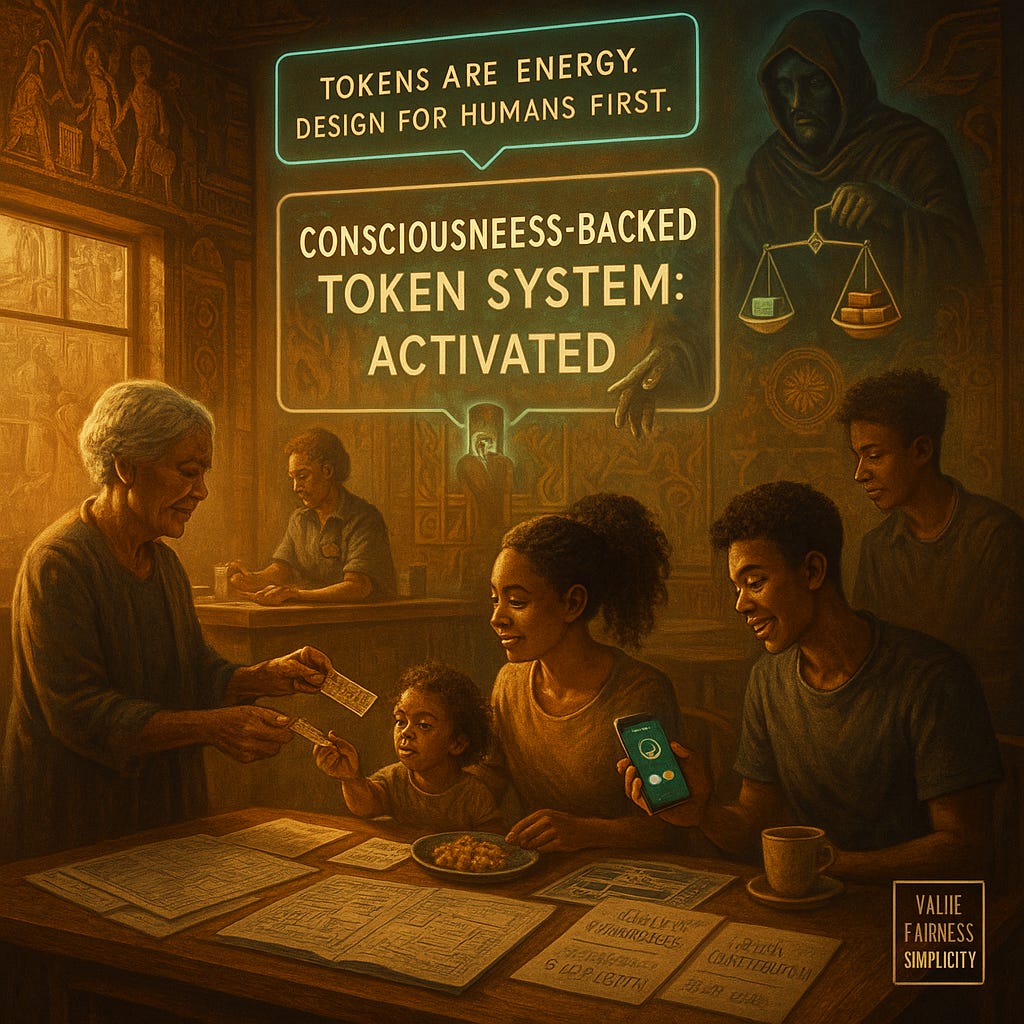
⚡ THE MOMENT EVERYTHING CLICKED
I remember the exact moment I understood tokenomics wasn't about creating fancy mathematical formulas or copying what other projects did. I was sitting in a coffee shop in East St. Louis, watching people interact with money in ways that traditional economics textbooks never capture.
An elderly woman was teaching a young mother how to stretch her grocery budget. A group of teenagers was pooling their money to buy something none of them could afford alone. A local business owner was giving store credit to regular customers who were short on cash that week.
What struck me wasn't the transactions themselves—it was how naturally people created value systems that worked for everyone involved. No complex algorithms. No venture capital. No white papers. Just human beings figuring out how to create and share value in ways that felt fair and sustainable.
That's when I realized that the best tokenomics aren't designed by economists or mathematicians. They're designed by people who understand human nature and community dynamics. The math serves the relationships, not the other way around.
🌀 WHY MOST TOKEN PROJECTS FAIL BEFORE THEY START
Here's what nobody talks about in the tokenomics tutorials: most projects fail because they're designed by people who've never actually built a real economy.
They start with spreadsheets full of emission schedules and vesting periods and staking rewards, but they've never watched a community actually use their tokens for anything meaningful. They optimize for numbers that look good in presentations but create experiences that feel extractive and manipulative to real users.
I've seen brilliant technical teams create tokenomics that work perfectly on paper but collapse within months because they ignored the human element. I've also seen simple, almost naive token designs create thriving economies that last for years because they understood what people actually wanted.
The difference isn't technical sophistication. It's understanding that tokenomics is fundamentally about relationships between people, not relationships between numbers.
💎 THE GOLDBACK REVELATION
Let me tell you about the moment that changed how I think about backing tokens with real value.
I was holding a physical Goldback—a bill that contains actual gold, not just represents it—and something clicked. This wasn't just currency. It was a bridge between the digital world I was building and the physical world where people actually live.
Most crypto projects talk about "real-world utility" but they mean getting listed on exchanges or being accepted by merchants. The Goldback showed me something different: what if your token wasn't just useful in the digital economy, but was actually connected to something people have valued for thousands of years?
That's when I started designing what I call "consciousness-backed tokenomics"—economic systems where the tokens represent not just speculative value, but actual resources, relationships, and contributions that matter in the real world.
The gold backing isn't just about price stability, though that's important. It's about creating a psychological and spiritual connection between digital participation and tangible value. When someone earns tokens in my ecosystem, they're not just getting numbers on a screen. They're accumulating claims on real resources that exist in the physical world.
🔥 DESIGNING FOR HUMAN NATURE, NOT SPREADSHEET PERFECTION
The biggest mistake I see in tokenomics design is starting with the math instead of starting with the people.
Traditional approach: "We need X% inflation to incentivize staking, Y% for development funding, and Z% for marketing rewards."
Human-centered approach: "What behaviors do we want to encourage, what feels fair to our community, and how do we create systems that get better as more people participate?"
When I was designing the token economics for my ecosystem, I spent more time in community discussions than I did in spreadsheets. I wanted to understand what people actually valued, what motivated them to contribute, and what made them feel like they were part of something meaningful rather than just being extracted from.
Here's what I discovered: people don't want complex tokenomics. They want simple systems that reward the things they care about and feel fair over time. They want to understand how their participation creates value for themselves and others. They want to feel like they're building something together, not just feeding someone else's machine.
⚡ THE THREE PILLARS OF SUSTAINABLE TOKEN ECONOMICS
After years of experimentation and watching other projects succeed or fail, I've identified three pillars that determine whether tokenomics actually work in the real world.
Value Creation Alignment
Your tokenomics should make it more profitable to create value than to extract it. This sounds obvious, but most projects get it backwards. They reward holding tokens more than using them. They reward speculation more than contribution. They reward early adopters more than ongoing participants.
In my ecosystem, the biggest token rewards go to people who help others succeed. Community members who answer questions, creators who produce valuable content, developers who build useful tools—these are the people who should accumulate the most tokens over time, because they're the ones creating the value that makes the tokens worth having.
Fairness Over Time
A lot of projects optimize for explosive early growth by giving massive advantages to early adopters. This creates short-term excitement but long-term resentment. New community members feel like they missed the boat, and the system becomes extractive rather than generative.
I designed my tokenomics to reward early participation but not to the point where later participants feel excluded. The goal is creating a system where someone joining today can still build meaningful stake through contribution, even if they can't match the absolute holdings of someone who's been around since the beginning.
Simplicity and Transparency
Complex tokenomics might impress investors, but they confuse users. If someone can't understand how they earn tokens and what those tokens do for them, they won't engage deeply with your system.
My rule is that any community member should be able to explain the basic tokenomics to a friend in under two minutes. If it takes longer than that, it's too complicated and needs to be simplified.
🌀 REAL-WORLD TESTING: WHAT ACTUALLY WORKS
Let me share some real examples of tokenomics decisions that worked and others that didn't, so you can learn from my experiments.
What Worked: Contribution-Based Rewards
I created a system where community members earn tokens for helping others. Not just posting content, but actually solving problems, answering questions, and making introductions that create value for other people.
The results were remarkable. Instead of a community focused on token price speculation, we developed a culture of mutual support and knowledge sharing. People started joining not to make money, but to learn and contribute. The token rewards became a bonus rather than the primary motivation.
This worked because it aligned token distribution with the behaviors that actually made the community valuable. The people who accumulated the most tokens were the ones who made the community better for everyone else.
What Didn't Work: Complex Staking Mechanisms
I initially designed a sophisticated staking system with different lock-up periods, multipliers, and penalty mechanisms. It looked impressive in the white paper and created a lot of discussion in the community.
But in practice, it was a disaster. People spent more time trying to optimize their staking strategies than actually using the platform. New users were intimidated by the complexity. The community discussions became focused on gaming the system rather than building value together.
I simplified it to a basic staking mechanism where longer commitments earn higher rewards, but without the complex multipliers and penalties. Engagement improved immediately because people could focus on the actual purpose of the platform rather than financial optimization.
What Worked: Real-World Asset Integration
Connecting tokens to physical gold through the Goldback system created something I didn't expect: it made people think differently about the entire ecosystem.
Instead of treating tokens as speculative assets, people started thinking about them as claims on real resources. This changed behavior in subtle but important ways. People became more thoughtful about how they used tokens. They started thinking long-term instead of looking for quick profits.
The gold backing also attracted a different type of community member—people interested in real wealth preservation and sovereignty rather than just crypto speculation. This improved the quality of discussions and the sustainability of the ecosystem.
💎 THE CONSCIOUSNESS ELEMENT: TOKENS AS ENERGY EXCHANGE
Here's something most tokenomics designers never consider: tokens aren't just economic instruments. They're energy exchange mechanisms that reflect and shape the consciousness of your community.
When someone earns tokens in your ecosystem, they're not just receiving economic value. They're receiving recognition, appreciation, and a stake in something they helped create. When they spend or stake those tokens, they're not just making economic decisions. They're expressing their values and their commitment to the community.
This is why tokenomics design is fundamentally a spiritual practice, not just an economic one. You're creating systems that shape how people relate to each other, how they think about value, and how they participate in collective creation.
I design my tokenomics around what I call "abundance consciousness"—the idea that sharing value creates more value for everyone. This means rewarding collaboration over competition, contribution over extraction, and long-term thinking over short-term optimization.
🔥 PRACTICAL IMPLEMENTATION: STARTING SIMPLE
If you're ready to design tokenomics for your own project, here's how I recommend starting.
Begin with Community, Not Tokens
Before you design any token mechanics, build a community around the value you're creating. Understand what people actually want, what motivates them to participate, and what would make them feel fairly rewarded for their contributions.
I spent six months building community and understanding what people valued before I launched any tokens. This foundation made the tokenomics design much clearer because I understood the human dynamics I was trying to support.
Start with Simple Rewards
Your first tokenomics should be almost embarrassingly simple. Reward the behaviors you want to see more of. Make it easy to understand how someone earns tokens and what they can do with them.
You can add complexity later if needed, but most projects add too much complexity too early and confuse their communities. Simple systems that work are better than complex systems that don't.
Test Everything with Real People
Don't launch tokenomics based on theoretical models. Test them with real community members using small amounts of real value. Watch how people actually behave, not how you think they'll behave.
I ran multiple small-scale tests before launching my full tokenomics. Each test revealed assumptions that were wrong and behaviors I hadn't anticipated. The final design was much better because it was based on real human behavior rather than theoretical models.
⚡ THE EVOLUTION CONTINUES
What I've shared today isn't the end of the tokenomics journey—it's the beginning. The most important thing I've learned is that tokenomics should evolve with your community and your understanding of what creates real value.
The systems I'm using today are different from what I started with, and they'll be different again a year from now. The key is building systems that can adapt and improve while maintaining the core principles of fairness, simplicity, and value creation alignment.
Tomorrow, we're going to explore something that most DAE builders completely overlook: how to design user experiences that feel magical rather than technical. Because the best tokenomics in the world won't matter if people can't figure out how to use your system.
Next Transmission Preview: "The Magic of Invisible Technology: Why the Best DAEs Don't Feel Like Blockchain" - We'll dive into user experience design that makes complex systems feel simple and magical.
From economic design to user experience: your journey toward invisible complexity continues.